I often spend my early mornings on the porch, recounting the wires outside my house (twenty-four in total, including the electric, phone, cable and a couple of unidentifiable ones) while I take in my morning nicotine hit. My neighborhood is a closed ‘colony’ with no shops or commercial activity allowed inside its premises, so I was surprised to find a billboard advertising the “naturally thick relationship of Haleeb with Pakistan”, along with a Pakistani flag right outside my house on one of my favorite poles last week (true, the pole isn’t exactly pretty, but the billboard was uglier).
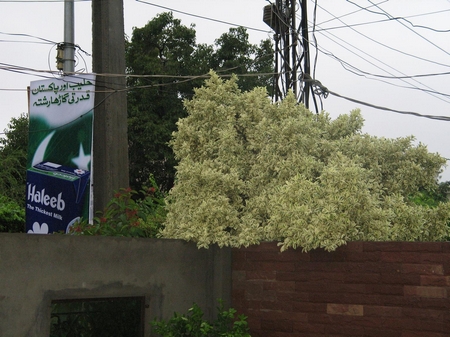
So, in the evening, when my son asked me if ‘our neighbors would think we have started selling milk and come to buy some’, I started thinking of my options to get rid of the hideous billboard.
- There was the pacifist approach – going to the colony committee (or whatever they call themselves) and asking them how and why they allowed these hideous billboards inside and how much money was involved.
- There was the vandalistic(?) approach – taking a can of black paint and painting them all black (ala The Rolling Stones)
- There was the extremist approach – taking a knife and slashing away the billboard.
- There was the activist approach – pasting these “You don’t need it” stickers from the Anti-Advertising Agency on all the billboards and taking a picture, and perhaps contacting the agency handling Haleeb campaigns

As I did not have a printer readily available, so I was inclined towards the one that let me use a knife. Before I could hack and slash however, the billboards were gone on the 16th of August.
I used to think that we do not have underground electricity in most of Lahore due to the high installation costs, but my new conspiracy theory is that the advertising agencies probably pay LESCO and PTCL to make sure they have plenty of poles available.
We should take a long and hard look at Brazil. Before we can solve a problem, first we have to identify it and acknowledge its existence. Only then can we come together and draw the lines to make our city/country a better place and improve our quality of life just a tiny bit.
Haleeb, by the way, is not getting any more of my business in the future.
 While a tiny percentage of our Pakistani population is protesting for fair treatment to Dr. Aafia Siddiqui, it looks like the US FBI is as confused as we are about the truth regarding her case.